There’s a moment many people have — usually while standing in a cluttered room, surrounded by things they don’t need and can’t quite remember buying — when the idea of minimalism stops being an aesthetic and starts feeling like a genuine relief. A minimalist home interior isn’t just about having fewer things on your shelves. Done well, it’s a way of living that reduces visual noise, lowers stress, and makes even a modest space feel open and considered.
The tricky part? Most minimalist interiors you see online look stunning for a photo shoot and impractical for an actual life. This guide is about creating a minimalist home style that holds up over time — not just for the first weekend after you’ve decluttered, but for years.
What Minimalist Interior Design Actually Means
Minimalism in interior design is often misunderstood as a cold, stark aesthetic — white walls, no personality, and nowhere comfortable to sit. In reality, minimalist interior design is built on a principle of intentionality: every object in a space should serve a purpose or bring genuine joy, and nothing should be there simply out of habit or because it was on sale.
The style has roots in Japanese design philosophy, particularly the concept of ma — the idea that empty space is not wasted space, but rather a meaningful element in itself. It also draws from the Bauhaus movement and Scandinavian design traditions, both of which prioritised function, craftsmanship, and restraint over ornamentation.
Minimalist spaces typically share a few core characteristics:
- Neutral or limited colour palettes — whites, greys, warm beiges, and earthy tones dominate
- Clean lines — furniture and architectural details tend to be simple and geometric
- Intentional negative space — surfaces are left clear rather than filled
- High-quality materials — because fewer items are on display, quality matters more
- Functional storage — clutter is hidden rather than eliminated entirely
It’s worth noting that minimalism doesn’t mean emotionless. A well-placed piece of artwork, a single sculptural plant, or a beautifully textured throw can carry enormous visual weight in a pared-back room — arguably more than a dozen competing decorative items ever could.
Why Minimalist Homes Are So Hard to Maintain (And How to Fix That)
According to a survey by the National Association of Professional Organisers, 54% of Americans feel overwhelmed by clutter, and 78% have no idea how to deal with it. While UK-specific data tells a similar story — the average British home contains around 300,000 items — the real challenge for minimalism isn’t the initial clear-out. It’s what happens six months later.
The reason most minimalist interiors don’t last is because they’re treated as a one-time project rather than an ongoing approach. People declutter over a weekend, style their home beautifully, and then gradually refill it with purchases, gifts, and the general accumulation of everyday life. Within a year, they’re back where they started.
Lasting minimalism requires two things: systems and habits. The aesthetic is a result of those two things — not the starting point.
Build Systems Before You Decorate
Before choosing furniture or paint colours, think about where things actually live in your home. Every item that enters your space needs a designated place. This sounds simple, but most homes fail at this basic level — things get piled on counters, chairs, and spare rooms because there’s nowhere obvious to put them.
Good storage is the backbone of a minimalist interior. Closed storage — wardrobes, cupboards, drawers — is particularly useful because it removes visual clutter without requiring you to own fewer things. The minimalist look comes from clear surfaces; what’s behind the doors is your business.
Apply the “One In, One Out” Rule Consistently
This is one of the most practically effective habits for maintaining a minimalist home over time. For every new item that enters the house — a new cushion, a piece of clothing, a kitchen gadget — one existing item leaves. It keeps the overall volume of possessions stable without requiring constant audit sessions.
How to Start Creating a Minimalist Home Interior
Whether you’re starting from scratch in a new home or trying to rework a space that’s grown chaotic over time, the approach is broadly the same. Begin with what you have before buying anything new.
Start Room by Room, Not All at Once
Attempting a whole-house minimalist transformation over a single weekend is a reliable route to burnout and regret. Instead, choose one room — ideally a living room or bedroom, where the visual impact of decluttering is most immediately felt — and work through it properly before moving on.
Remove everything from the room that isn’t furniture. Then, rather than putting things back, ask yourself which items genuinely belong in that space. Be honest. Many objects end up in rooms simply because there was a convenient surface nearby.
Curate Rather Than Decorate
The difference between decorating and curating is intention. Decorating is adding things to fill a space. Curating is selecting specific pieces that serve or mean something, then arranging them thoughtfully.
In a minimalist living room, for example, this might mean choosing a single large piece of artwork rather than a gallery wall, or displaying three carefully chosen books rather than a full shelf. Each item should feel deliberate — as though it was placed exactly there for a reason, because it was.
Embrace Texture Over Pattern
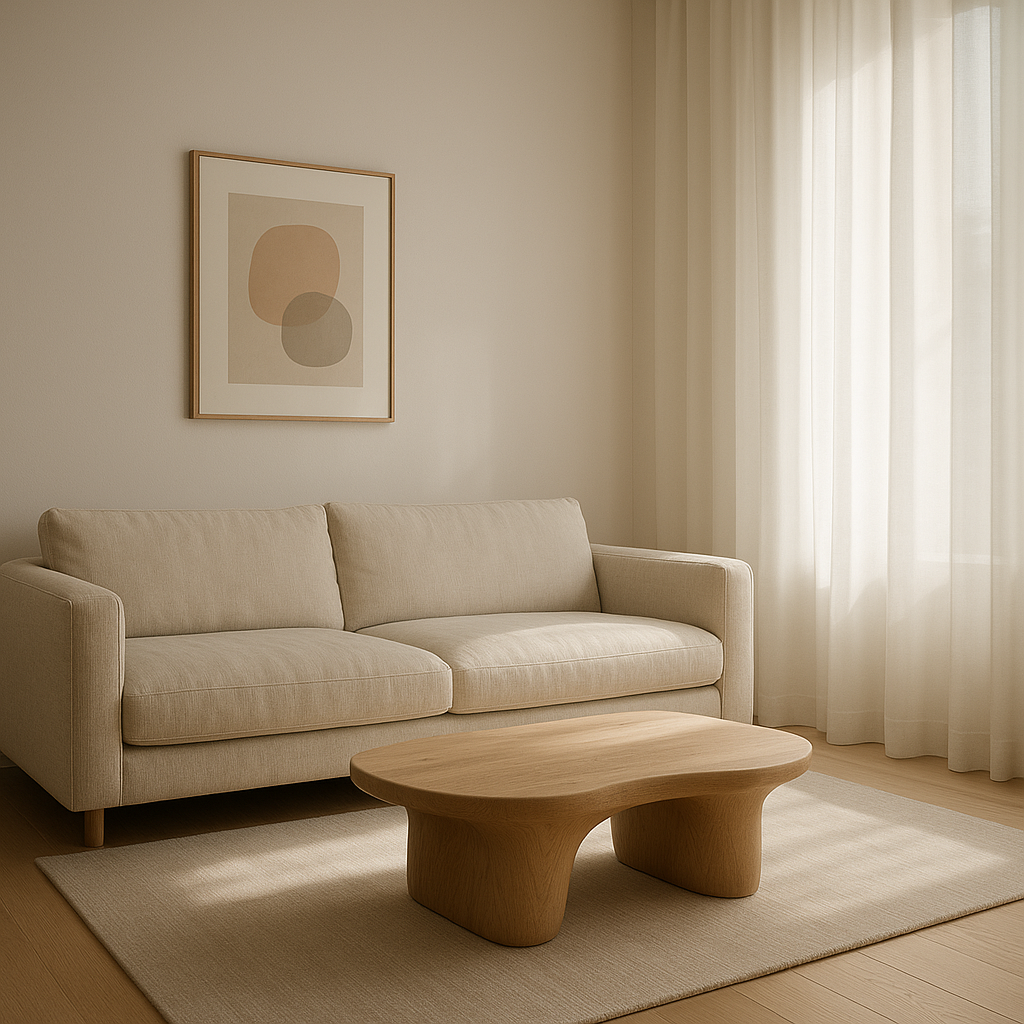
One of the most common concerns about minimalist interiors is that they’ll feel bland or cold. The solution isn’t to add more objects — it’s to add texture. A linen sofa, a jute rug, a knitted throw, rough-hewn wooden furniture, or a matte ceramic vase all add visual and tactile interest without introducing the busyness of pattern or colour.
Texture is how minimalist interiors achieve warmth. It’s particularly important in bedrooms and living rooms, where comfort matters as much as aesthetics.
Minimalist Interior Design for Small Homes
Minimalism is especially well-suited to smaller homes and flats, where the relationship between space and objects is more acutely felt. A cluttered small room feels oppressive; a decluttered one can feel genuinely spacious, even if the square footage hasn’t changed.
A few principles are particularly relevant for small spaces:
- Choose furniture with legs — pieces that sit off the floor create a sense of space beneath them, making a room feel less dense
- Use mirrors strategically — a well-placed large mirror can visually double the perceived size of a room
- Go vertical with storage — tall shelving units use wall height rather than floor space, keeping the room’s footprint clear
- Limit the number of large furniture pieces — in a small living room, one good sofa will serve better than a sofa plus a loveseat plus an armchair
- Keep flooring consistent — using the same flooring throughout (rather than switching materials room to room) makes a small home feel more connected and spacious
It’s also worth resisting the urge to fill every corner. Empty corners in a small room feel intentional, not forgotten — and they give the eye somewhere to rest. If you’re working with limited square footage, maximising style and functionality in tandem becomes especially important.
Colour in a Minimalist Home
Minimalist design doesn’t mandate white walls. While white and off-white tones are popular because they maximise light and create a clean backdrop, the real rule is restraint rather than any specific colour.
A deep sage green, a warm terracotta, or a soft charcoal can all work beautifully in a minimalist context — as long as the palette remains cohesive and limited. Choosing one or two anchor colours and using them consistently throughout a home creates a sense of calm continuity that is very much in keeping with the minimalist ethos.
What tends to break a minimalist aesthetic isn’t bold colour — it’s inconsistency. A room that contains ten competing colours and patterns will feel cluttered regardless of how few objects it contains.

Common Mistakes to Avoid
Even with the best intentions, certain pitfalls catch people out when they’re trying to create a genuinely minimalist interior.
Confusing Minimalism With Buying New Things
There’s an ironic trend in minimalist spaces online: they often feature a great deal of very expensive, very carefully chosen new furniture and accessories. While quality over quantity is a legitimate minimalist principle, the idea that achieving minimalism requires a significant shopping trip misses the point entirely. Many people have everything they need — they simply need to subtract, not add.
Removing Too Much, Too Fast
Aggressive decluttering can lead to regret, both emotional and practical. It’s worth proceeding thoughtfully — particularly with sentimental items. A useful approach is to box up items you’re uncertain about and store them for thirty or sixty days. If you don’t miss them, they can go. If you do, they come back in.
Neglecting Functionality
A minimalist home should work as a home first. If you’ve decluttered to the point where your kitchen lacks basic equipment or your children have nowhere to put their belongings, the aesthetic has overtaken the function — which is not what minimalism is supposed to achieve. The style exists to support a better quality of life, not to complicate it.
Bringing It All Together Over Time
Creating a minimalist home interior that lasts isn’t something that happens over a weekend. It’s an evolving relationship with your space — one that becomes easier and more intuitive over time as you develop a clearer sense of what you actually need and value.
The most durable minimalist homes tend to belong to people who have stopped thinking of minimalism as a design trend and started thinking of it as a framework for decision-making. Each purchase, each gift accepted, each item kept gets considered through the same lens: does this belong here? Does it serve something? Does it earn its place? In many ways, this mirrors the process of developing a personal style that reflects your values — both are about conscious choices rather than defaults.
When that question becomes second nature, the aesthetic takes care of itself.
Final Thoughts
Minimalist interior design, at its best, is less about the way a home looks and more about the way it feels to live in. The visual calm that draws so many people to the style is really just a byproduct of more deliberate choices about objects, space, and what actually matters in a home.
The key points to carry forward are these: start with systems before aesthetics, work gradually rather than all at once, prioritise texture and quality over quantity, and treat minimalism as a habit rather than a project. For small homes especially, the approach can be genuinely transformative — creating a sense of space and ease that has nothing to do with how many square metres you actually have.
Most importantly, a minimalist home should feel like yours — considered, comfortable, and suited to your actual life rather than an imagined one.